 Cantos Cautivos
About the Project
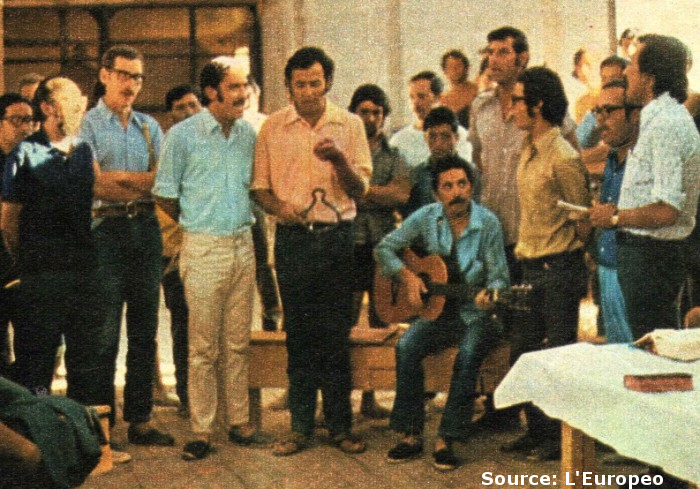
“Los de Chacabuco”, a group created and directed by Ángel Parra. Chacabuco concentration camp
The site contains 168 testimonies collected between December 2014 and June 2025, of which 40 refer to music pieces fully created in detention and 12 refer to music pieces with lyrics created or modified in detention over pre-existing music. To see the testimonies, click here.
To collect materials, the project combined online crowdsourcing with edited transcriptions of oral testimonies obtained through interviews and events.
Praised as “an extraordinary digital archive” by Alex Ross (critic of The New Yorker), Cantos Cautivos seeks to contribute to the historical memory of the dictatorship and to debates on human rights in other historical and geographical contexts.
The project was conceptualised by Katia Chornik in 2014 and developed initially in collaboration with the Museum of Memory and Human Rights (Santiago, Chile). Between 2016 and 2025, the project ran independently, using a website developed by Hernán Theiler.
Since 2026, the Cantos Cautivos project has been part of the collections of the Archivo Central Andrés Bello of the Vicerrectoría de Extensión y Comunicaciones of the Universidad de Chile. This integration is by virtue of the authorisation of use of the work signed on 20 November 2025, which permits its public communication, availability on the web, reproduction and development by the team of the Unidad de Estudios y Datos of that vice-rectorate.
The project's milestones include its inclusion in the British Museum's I Object, Ian Hislop's Search for Dissent exhibition (2018–19) and the development of a UNESCO educational booklet to support the use of the Cantos Cautivos archive in school classrooms.
The ideas expressed in the exhibited materials are the responsibility of their authors and do not necessarily represent the ideas of the Archivo Central Andrés Bello of the Vicerrectoría de Extensión y Comunicaciones of the Universidad de Chile.
The work Cantos Cautivos is registered in the Registro de Derechos Intelectuales N° 294916 of the Servicio Nacional del Patrimonio Cultural of Chile. The holders of the intellectual rights of the work are Katia Chornik and Hernán Theiler.
The project has received funding from: